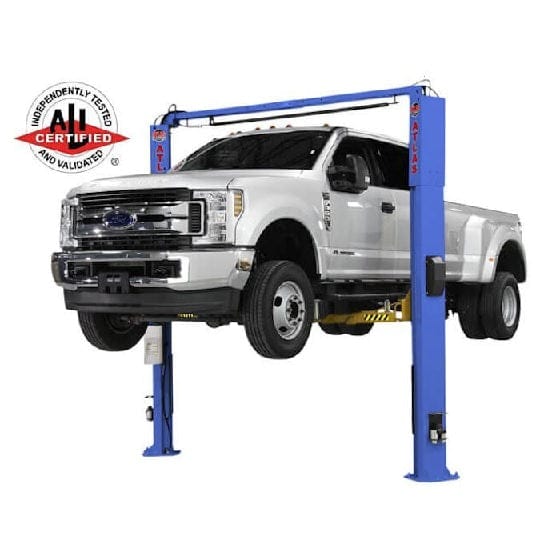
Most car lift regret starts the same way: the lift fit the car, but not the garage. Capacity gets all the attention, yet the three things that actually disqualify lifts are ceiling height, concrete, and power. Work through those in order and the right lift usually picks itself.
Overhead two-post lifts are out — their crossbeams need more room than you have. What works: mid-rise scissor lifts like the Katool KT-X90E (8,000 lb, 47-inch rise, runs on a regular 110V outlet), which lift the car high enough for brakes, wheels, and underbody work while clearing a low ceiling.
This is floor-plate and base-plate two-post territory: the equalization cables run across the floor instead of overhead, so there's no crossbeam above the vehicle. The Triumph NT-9 was designed specifically for low-ceiling home garages, and the Katool H115Z brings 11,000 lb capacity with no overhead beam at all.
Everything opens up: overhead two-post lifts — like the Katool KT-AS110D (141.25" overall height, so a bay just under 12 feet clears it) — and full-height four-post lifts for stacking or storage.
A lift is only as strong as what it's bolted to. Two-post lifts put all the load through their anchor bolts: Katool's two-posts require a minimum 5.9-inch slab at 3,000 PSI. Four-post lifts spread the same weight across four wide feet, so they typically need only a 4-inch slab at 3,000 PSI — which is why a four-post is often the honest answer for garages with older or thinner floors. Check your slab before you buy, not after: every manual we host lists the exact requirement, and it is not a suggestion.
Most lifts want a dedicated 220V single-phase circuit — plan for the electrician if you don't have one. If you'd rather skip that entirely, some models run on household power: the Katool KT-4H110 four-post offers a 110V configuration at checkout, and several scissor lifts run 110V natively.
Overhead two-posts generally need about 12 feet. Floor-plate and base-plate designs work in 10-foot garages because nothing crosses above the vehicle. Under 10 feet, choose a mid-rise scissor lift.
Most four-post lifts, yes — they typically require a 4-inch, 3,000 PSI slab. Most two-post lifts need thicker concrete (Katool specifies 5.9 inches minimum) because the anchors carry the full load. Verify against the specific product manual.
Yes — several mid-rise scissor lifts and the 110V configuration of some four-posts run on standard household power. Overhead two-posts almost always want 220V.
The one that fits your building. An 11,000 lb two-post you can't legally anchor into your slab is worth less than an 8,000 lb four-post that installs correctly and works every day.
Not sure which way your garage points? Call or text (307) 381-1810 — we'll talk through your ceiling, slab, and vehicles before you spend anything. Browse the full car lift range to see what's in stock.
{"one"=>"Select 2 or 3 items to compare", "other"=>"{{ count }} of 3 items selected"}