
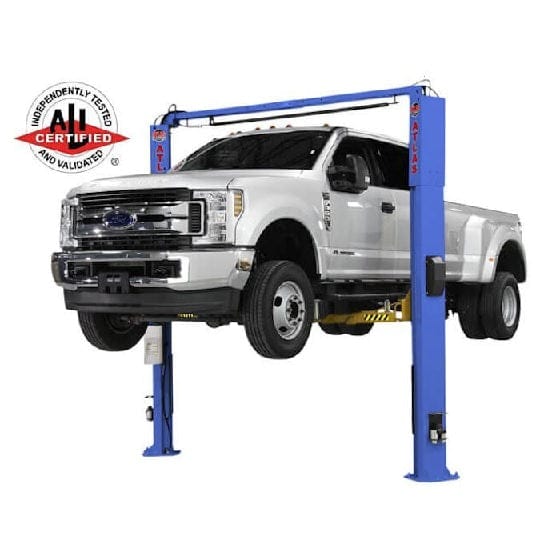
Description
-The Katool KT-AS110D is an 11,000 lb capacity asymmetric two-post lift — the configuration shops pick when door access matters. The three-stage front arms tuck short (29.9") so the vehicle sits back in the bay, letting doors swing open past the columns instead of into them, then extend to 61" for frame-contact points on long vehicles. Rear two-stage arms cover 30.7"–50.4". It is CE Approved and Certified, built to the 115% dynamic loading standard and tested at 150% static load.
Lifting is by direct-drive hydraulic cylinders — no chains in the drive path — and lowering is handled from one station: the single-point lock release drops both columns' locks together, no walking around the vehicle with a bar. A padded overhead safety shutoff bar stops travel before a roof meets the crossbeam, rubber door-opening pads protect panels during positioning, and feet-protection guardrails with an integrated toolbox keep the base area safe and organized.
The columns are Q235 and Q245 steel, and the adjustable support adapters extend from 3.94" to 6" for frame-rail contact on trucks and SUVs. The power unit runs 220V/60Hz single-phase, with a 110V option for garages without a 220V circuit — and the lift ships from five US warehouses (Los Angeles, Chicago, Houston, New York, Savannah).
Prefer a symmetric setup for heavier, centered loads? The Katool KT-M110 clear-floor two-post is the same 11,000 lb class with symmetric arms.
Features
-- 11,000 lb capacity, CE Approved — 115% dynamic / 150% static tested.
- Asymmetric arm design: 3-stage front arms (29.9"–61"), 2-stage rear arms (30.7"–50.4").
- Direct-drive cylinders and single-point lock release.
- Padded overhead safety shutoff bar.
- Rubber door-opening protection pads on both columns.
- Feet-protection safety guardrails with integrated toolbox.
- Adjustable support adapters, 3.94" to 6".
- Q235/Q245 steel construction, 3/8" lifting cables.
- 220V/60Hz single-phase standard; 110V optional.
Specifications
-| Katool KT-AS110D Specifications | |
|---|---|
| Lifting capacity | 11,000 lbs (4,990 kg) |
| Max lifting height | 70.75" (1,800 mm) |
| Min pad height | 3.74" (95 mm) |
| Overall height | 141.25" (3,587 mm) |
| Overall width | 134.65" (3,420 mm) |
| Width outside columns | 120.4" (3,058 mm) |
| Width inside columns | 109.37" (2,778 mm) |
| Drive-thru clearance | 99.61" (2,530 mm) |
| Front arm reach (3-stage) | 29.9" – 61" (760–1,550 mm) |
| Rear arm reach (2-stage) | 30.7" – 50.4" (780–1,280 mm) |
| Support adapters | 3.94" – 6" adjustable |
| Materials | Q235 and Q245 steel |
| Motor | 220VAC/60Hz/1PH (110V optional) |
| Net weight | 1,323 lbs (600 kg) |
| Concrete: minimum 5.9" (150 mm) thickness at 3,000 PSI. Verify your slab before installation. | |
Warranty
-Katool covers the KT-AS110D with a 12-month all-parts warranty — cylinders, power unit, motor, and electronics — plus a 3-year warranty on structural components. Replacement parts ship free; labor is not included, and claims require the original order number.
FAQ
-Why asymmetric instead of symmetric?
Asymmetric arms set the vehicle rearward so doors open past the columns — the practical difference is getting in and out of the car while it is on the lift. For heavier, centered loads where door access matters less, a symmetric lift like the KT-M110 spreads weight evenly.
Do I need 220V power?
The standard power unit is 220V/60Hz single-phase; a 110V option is available — specify it when ordering if your garage lacks a 220V circuit.
What concrete do I need?
Minimum 5.9" (150 mm) thickness rated 3,000 PSI. The columns are supported entirely by their anchors, so this is a hard requirement, not a suggestion.
How tall does my ceiling need to be?
Overall height is 141.25" — a bay just under 12 feet clears the crossbeam, and the overhead shutoff bar protects tall vehicles from being raised into it.
Documents
-Videos
-Katool's official product walkthrough:
Installation guide:
Frequently Asked Questions (FAQs)
Welcome to My Garage Supplies! We're here to assist you in your journey to find the best garage-related products. Please explore the sections below to find answers to common questions you might have.