
The QuickJack vs MaxJax comparison is interesting. Both portable lifts are owned by the same parent company (BendPak). So what distinguishes them from each other - and more importantly, which is right for YOUR work?
It really comes down to how much weight you need to lift and whether or not your garage floor can handle concrete anchors. QuickJack is a low-profile frame system that slides under your vehicle and raises it roughly 24 inches. MaxJax is a true two-post lift that can raise your car up to 47 inches for full standing access.
Budget plays a role too - QuickJack costs under $2k. MaxJax starts at $5k. We’ll look at some of the other nuances you need to know to feel confident picking between MaxJax vs QuickJack. We’ll also help you decide if it’s worth looking into a full-size car lift for garage.
|
Feature |
QuickJack (6000TL) |
MaxJax (M7K) |
|
Lift Type |
Low-profile frame system |
Portable two-post |
|
Capacity |
6,000 lbs |
7,000 lbs |
|
Max Lift Height |
24” (26.75” with adapters) |
47.25” (50.5” with adapters) |
|
Collapsed/Stored Height |
3.5” |
89.5” (columns) |
|
Weight Per Side |
78 lbs per frame |
300 lbs per column |
|
Rise Time |
30 seconds |
45 seconds |
|
Concrete Anchoring |
None required |
Required (2,500+ PSI slab) |
|
Safety Locks |
Dual-position automatic |
7-position automatic |
|
ALI Certified |
Yes |
Yes |
|
Price (MSRP) |
$1,925 |
$5,195 (Standard package) |
|
Warranty |
1 year (2-year extension available) |
3 years structure / 2 years hydraulic / 1 year electrical |
This portable two-post car lift was first designed by Garage Equipment Supply, but BendPak bought the brand back in 2020. BendPak is widely known as one of the best car lift brands, and they spent six months iterating the original design.
Today’s MaxJax model is the M7K. It has a 7,000 lbs lift capacity and provides over 47 inches of full rise to bring vehicles up to a comfortable working height. You can access everything from wheels and brakes to the undercarriage, engine, and transmission.
The flush-mounted concrete anchors stay in your floor - which begs the question, how is this a portable lift? The columns themselves unbolt and roll out of the way on built-in urethane wheels. It only takes 15 minutes to set the system up. Plug it into any 110V outlet.
It’s not cheap, but it’s also one of the only lifts of its kind. You can choose from four packages, starting at $5,195 (Standard) and working all the way up to $5,695 (Ultimate). The package you choose dictates which accessories you get (oil drains, tall adapter pins, rolling work seats, etc.).
QuickJack is the low-profile portable car lift system from BendPak. Yep, same company. It’s a totally different approach, though.
You put two individual frames on your garage floor, and slide them under the car’s recommended jacking points. The electric power unit activates the hydraulic system to get your car off the ground - albeit only 24 inches. It may not get your vehicle to full working height, but QuickJack can still lift 6,000 lbs with ease.
The flagship model (6000TL) has a 70-inch frame. You can upgrade to the 6000TLX for cars with longer wheelbases (76-inch frame). The 6000ELX has an extra-long 86.75-inch frame specifically for EVs. Or, go even bigger with the 8000TL and 8000TLX. Both of these are rated at 8,000lbs for SUVs and trucks.
Prices range from $1,925 up to $2,325. Way more affordable than the other half of the QuickJack vs MaxJax comparison. You don’t have to deal with any bolting into your concrete, either. It’s a truly portable lift as the frames weigh as little as 78lbs each and sit on urethane wheels. Roll them into position, lift your car, do the job, and stow the frames against a wall.
There’s a little overlap when you look at QuickJack vs MaxJax side by side. They come from the same parent company, and both have ALI certification. But they’re very different in terms of how “portable” they are, the types of service they allow you to perform, what they cost, and where they actually work. Let’s take a closer look below.
The biggest difference between QuickJack vs MaxJax is how high each lift can raise your vehicle, and thus, the types of service they allow you to do.
QuickJack gives you legitimately half the height of the MaxJax. You’re on a creeper at just 24”, whereas 47.25” lets you work while standing or sitting.
But, QuickJack is actually the more capable lift as far as weight capacity goes. The QuickJack 8000TL has an 8,000lbs capacity compared to the MaxJax 7,000lbs capacity. Whether that’s a benefit or not depends on the types of vehicles you’re planning on lifting, though.
These are technically both portable lifts. How portable is the real question.
QuickJack is actually light enough for you to move around with ease and store it against the wall when not in use. The brand also offers wall hangers. Each frame is only 78lbs and collapses down to 3.5” (on the 6000TL). This is the lift to go with if you need to move it from one location to another on a regular basis - say, a track day, a friend’s shop, or across different bays.
On the other hand, MaxJax columns each weigh 300lbs. Moving them takes real effort. Or, a pallet jack. You have to roll the columns aside to reclaim your floor space, and even then, there are going to be flush-mounted anchors permanently etched in your slab.
Like we said earlier, each lift supports different types of vehicle service because of how high they can go. This could be the deciding factor for you between QuickJack vs MaxJax.
MaxJax opens up the kind of work that normally requires a permanent two-post lift. You can stand under the engine bay from below, pull a transmission, or swap a differential. The adjustable arms reach between 26 and 40 inches and let you work without crossbars in the way.
In contrast, QuickJack is really only viable for undercar maintenance. Oil changes, brake jobs, and maybe even exhaust and suspension work. As long as you can handle the job from a creeper, QuickJack is a good portable lift. Otherwise, it feels really limiting.
It’s so easy to unbox and begin using QuickJack. Slide the frame under your car, connect the pendant, and activate the hydraulic system to get to full height in 30 seconds.
MaxJax takes longer since you have to connect the columns to your pre-installed anchors, hook up the hydraulic hoses, position the arms, and then raise your vehicle. It takes around 45 seconds once everything is set up, but plan on around 10-15 minutes of setup and teardown.
This is another really important piece of context in choosing between QuickJack vs MaxJax. QuickJack doesn’t have any strict concrete requirements. It can be used on any hard, flat surface. No drilling, anchors, or slab inspection.
You can’t say the same for MaxJax. At the bare minimum, you need a 4” thick concrete slab rated at 2,500 PSI (cured for 28 days). You’ll have to drill flush-mounted drop anchors into the floor. They’re permanent. An architect must sign off on post-tensioned slabs before you drill. You can probably handle installation yourself, but a lot of buyers pay for professional installation.
Both lifts are ALI certified, so you can rest assured they’re been put through stringent third-party structural testing and manufacturing quality audits against ANSI standards. That’s rare for portable car lifts.
QuickJack has dual-position automatic safety locks with a pressure-compensated flow divider to synchronize the frames. MaxJax has 7 lock positions per column with lock bars that are capable of holding 3x the rated capacity. Its velocity-fuse valves prevent uncontrolled descent as well.
One final consideration as you ponder MaxJax vs QuickJack - price. Or more aptly, value for the money. One of these is far more affordable than the other, but you get what you pay for.
Just remember that MaxJax opens the door to service work that the QuickJack doesn’t. It has a much stronger warranty, too. 3 years on the lift structure, 2 years on hydraulic components, and 1 year on electrical. QuickJack is 1-year across the board (with an optional 2-year extension).
We know you came here curious about whether QuickJack vs MaxJax was right for you. But have you considered a full-fledged car lift for your garage? You’d be surprised - these are more affordable and practical than you think!
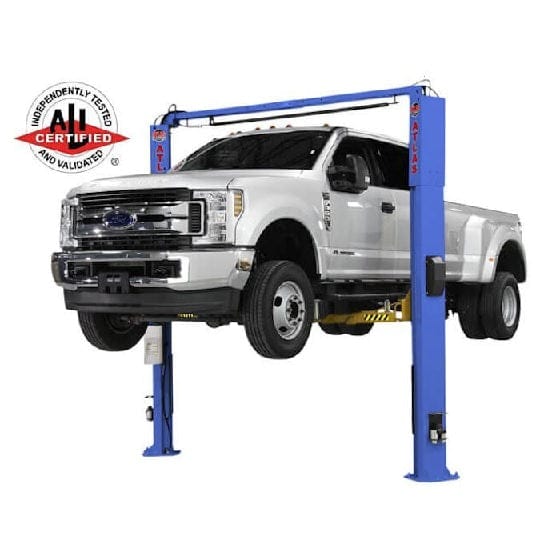
A permanent 2-post car lift gives you everything MaxJax offers and then some. Full-height clearance (70+ inches), 9,000-10,000lb capacities, and no setup/teardown needed. Prices start around $1,899 - less than MaxJax!
A 4-post car lift is the perfect middle ground between a QuickJack's portability and a two-post's workspace. You don’t have to anchor anything. Just drive your car onto the lift, raise it up, and work underneath.
A lot of models come equipped with caster kits so you can reposition the lift as needed. You can also use the lift to store a vehicle overhead. Prices start at around $2,699 for an 8,500lbs model.
Whether you decide to go with a 2-post lift, 4-post lift, or even a single-post car lift or scissor lift, look no further than My Garage Supplies. We carry all the top brands and their most sought-after models at the lowest prices, backed by world-class customer service.
Our team can help you weigh your options, too. Just connect with our experts today for personalized support in picking the perfect car lift!
We hope our MaxJax vs QuickJack comparison has left you feeling confident in which best suits your workflow and garage. They both have their place, and there’s plenty of overlap. But they’re different enough that choosing between QuickJack vs MaxJax should be relatively easy.
You can explore our blog for a EZCarLift vs QuickJack or Vevor vs QuickJack car lift comparison if you want to see what other options are out there. We also have a separate comparison of BendPak vs Rotary. Otherwise, take a look at our collection or connect with our team today!
{"one"=>"Select 2 or 3 items to compare", "other"=>"{{ count }} of 3 items selected"}