
We get asked all the time, how many amps does a car lift use? After all, the car lift electrical requirements can’t be overlooked as you start shopping for a new car lift for garage. As with most things related to garage equipment, though, there’s no one-size-fits-all answer.
Most home garage lifts we carry run on either 110V circuits drawing roughly 15-20 amps or 220V setups that typically land in the 20-30 amp range. It depends on motor size and lifting speed.
Low-rise and portable scissor lifts often plug into standard outlets, whereas full-height 2-post and heavier 4-post systems usually need a dedicated 220V breaker. That difference affects installation costs, panel capacity, and which lifts actually make sense for your space.
My Garage Supplies walks customers through real electrical requirements before they buy, matching lift specs to their panel, wiring, and garage layout so there are no surprises once the lift shows up. Get in touch today for personalized support!
First things first, you need to know what amps measure in the first place. This tells you how much electrical current a lift draws while the motor is running. That draw depends on three things when it comes to vehicle lifts:
Startup current is always higher than running current, which is why breaker size matters just as much as average amp draw. That being said, how many amps does a car lift use?
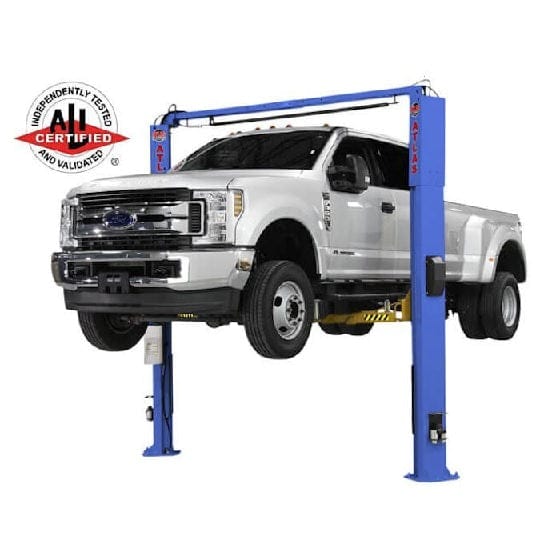
Most full-size 2-post car lifts use 220V, single-phase power with motors in the 2-5 HP range.
There are smaller 2-post models with 110V motors, but they usually lift slower and sit closer to the 15-20 amp ceiling of a standard circuit.
A 4-post car lift usually has higher car lift power requirements because it moves more total mass, given its longer runways. It’s more common to see 110V and 220V models in this style:
4-posts designed specifically for storage can be lighter, whereas service-grade lifts will almost always need 220V power.
A car scissor lift is the lightest you’ll have access to as far as car lift electrical requirements go. As you can imagine, that’s because they’re the lowest-duty.
These are some of the best residential garage car lifts because they’re easy to install and can often be moved around the garage when not in use. Speaking of which…
So, how many amps does a car lift use? It can also depend on whether the car lift is designed to stay in place or remain in one location. Most portable lifts can plug into standard outlets. They’re usually less than 20 amps. Fixed lifts with permanent wiring can pull up to 30 amps, though.
You’re probably starting to wonder about how 110V vs 220V car lifts compare by this point. It just comes down to lifting speed, electrical demand, and how the lift is actually used on a daily basis. The voltage dictates how much power the motor can draw before straining.
110V lifts connect to a standard household circuit to simplify installation in residential garages. Portable lifts, low-rise scissor lifts, and some storage-focused 4-post models are 110V.
Motors are usually smaller (often around 1HP) which translates to longer lift cycles, especially with heavy vehicles. They can still work fine for lighter service work, detailing, or occasional maintenance if electrical upgrades aren’t feasible.
220V lifts need a dedicated higher-voltage circuit. The payoff is stronger motor performance. Most full-size 2-post lifts and commercial-grade 4-post lifts use 220V power units in the 2HP-5HP range.
The added electrical capacity supports faster lifting speeds and more consistent performance when handling trucks, SUVs, or repeated daily cycles. Shops and serious home garages need 220V because it minimizes motor strain and keeps operation consistent.
One of the very first things you need to do before buying a car lift is take a close look at your electrical panel capacity and breaker layout. A lift motor may only run for short cycles, but it still needs a properly sized circuit to avoid nuisance trips or voltage drop during startup.
As you’re well aware by this point in our car lift electrical requirements guide, 220V lifts need a dedicated breaker in the 20-30 amp range, depending on motor size. Sharing the circuit with compressors, welders, or heaters can cause breaker trips when the lift starts under load.
Here are some other things you need to think about as far as car lift power requirements go:
It’s totally fine if some of the car lift electrical requirements feel above your pay grade. This is why having an electrician handle all the heavy lifting is worth it. But when it comes to choosing the right car lift, that’s where we come in.
My Garage Supplies helps customers match lifts to real-world garage power setups on a daily basis. We stock the best brands and their most popular models, and we know the specs like the back of our hand. That means you can rest assured you’re getting world-class guidance.
Let us walk you through panel capacity, voltage options, and wiring considerations before you buy, so there are no surprises during install. Browse our lineup or reach out for one-on-one support and get a lift that works with your garage from day one.
Even when a lift arrives ready to assemble, the electrical side should be handled by a licensed electrician. They can verify breaker sizing, confirm wire gauge, and install the correct outlet or hardwired connection based on the motor requirements.
This is going to pay off in terms of peace of mind if nothing else. But, a lot of brands will require you to have your lift professionally wired for warranty reasons as well. Don’t cut corners here!
So, how many amps does a car lift use? As we bring our car lift electrical requirements guide to a close, remember that there are a lot of moving pieces: voltage, motor size, and lift type.
Our blog has additional resources on car lift installation if you want to prepare yourself, like the car lift concrete requirements or the 2-post car lift space requirements. But with one-on-one support available here at My Garage Supplies, you don’t have to navigate any of this alone.
Get in touch with our experts today for personalized guidance from A to Z. We’ll help you narrow it down to the best car lift for your home garage or commercial shop and walk you through the next steps!
Most car lifts draw roughly 15-30 amps, depending on motor size. 110V portable units fall on the lower end, and 220V shop lifts usually need more dedicated power.
Breaker size usually ranges from 20A to 40A based on the motor rating listed on the lift data plate. It’s really important to match the manufacturer’s electrical specs.
Many 220V lifts use 10-gauge or 12-gauge copper wiring, but the exact wire size depends on amperage draw, distance from the panel, and local electrical code. Trust us, this is something you want to leave to an electrician.
Standard outlets in garages are often 15A or 20A circuits. Higher-capacity lifts typically require a dedicated 220V line installed separately.
Related: How much does a car lift cost? — real prices by lift type, plus the electrical and concrete work to budget alongside the lift.
{"one"=>"Select 2 or 3 items to compare", "other"=>"{{ count }} of 3 items selected"}