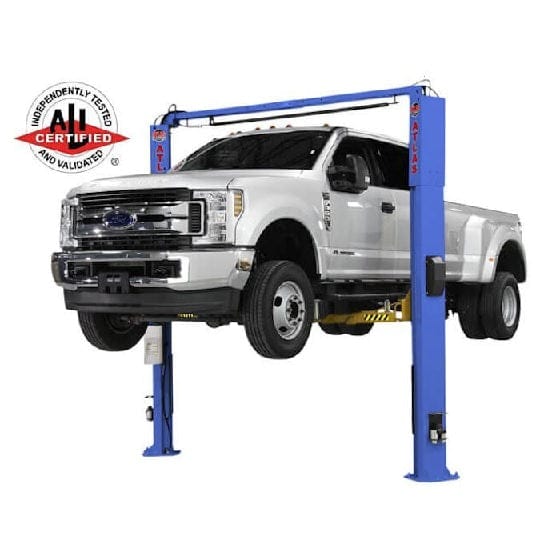

Whether it’s a home garage or a commercial automotive repair shop, a car lift is the most vital piece of equipment you’ll use. But how do car lifts work, exactly? It depends on the type of car lift in question. We’re going to walk you through key components and inner workings below.
MOST of them rely on hydraulic pressure or an electric-driven screw mechanism that raises steel arms or platforms under the vehicle. Hydraulic fluid or a threaded rod creates upward force as the pump or motor engages, lifting the car to a set height while mechanical locks support the weight.
After understanding the basics, the next step is outfitting your space with the right car lift for garage. That’s another thing we can help with. We carry the top car lift brands at the lowest prices online, backed by world-class customer service.
Get in touch with our experts today for one-on-one help finding the perfect lift for your shop.
So, how do car lifts work? They rely on a combination of components, including:
Every lift style, be it a 2-post car lift, 4-post car lift, or even a single-post car lift, relies on these same core components. Each part has a clear, mechanical job that keeps the lift stable while the vehicle is raised.
These vertical supports carry the load. They need to be incredibly strong to keep the lift rigid and prevent swaying.
A two-post lift’s columns anchor to the concrete and house the hydraulic cylinders, cables, and locking ladder. Four-post lifts use steel runways connected by crossbeams to spread the weight across a wider area.
Most lifts use hydraulic cylinders filled with fluid that moves under pressure. The pump activates, and fluid pushes the piston upward. This is what actually raises the arms or runways.
Some lifts (especially portable or low-rise models) use an electric screw drive that turns a threaded rod to create upward movement.
In either case, the mechanism is what actually lifts the vehicle off the ground. But it’s controlled by either an electric pump or motor unit.
This powers the lifting system we just described above. The on hydraulic models pump sends pressurized fluid into the cylinder. The motor on screw-drive systems spins the shaft. The power unit is usually mounted on one of the columns and connects to the lift via hoses/wiring.
These are the parts that physically carry the vehicle.
Two-post lifts use swing arms that lock into place under the vehicle’s lift points. Telescoping arms let you easily reach different chassis layouts.
On the other hand, four-post lifts use steel runways that support the wheels. You can learn more about the differences between a 2-post lift vs 4-post lift in our blog if you’d like.
There are also car scissor lifts, which raise a flat platform or two parallel tracks.
A lot of today’s lifts use steel cables or chains to keep both sides rising at the same pace. The cable passes over pulleys inside the columns as the hydraulic cylinder moves. This distributes force evenly so the lift reaches its full height without leaning. It prevents uneven lifting and protects the frame from twisting.
Every lift has a lock that engages automatically as the lift rises. This is usually a steel ladder welded inside the columns and a pawl that clicks into each step.
Once the lift reaches the height you want, you lower it slightly so the vehicle’s weight rests on the lock and isn’t just supported by hydraulic pressure. This prevents the system from being strained and keeps the car firmly supported during work.
These components keep the lift secure on the floor. Anchors keep the columns from shifting under load. This is especially prominent in 2-post systems. You don’t always need to anchor a 4-post lift.
Concrete thickness and strength matter because the anchors transfer the weight of the vehicle into the slab. Otherwise, your lift could shift during movement - and that’s the last thing you need when working underneath a multi-ton vehicle.
We have a separate resource on 2-post car lift concrete requirements.
Aside from the locks we touched on already, car lifts have other features to support safe operation. For instance, there’s usually a push-button or lever that raises the vehicle and a second control that vents pressure to lower it.
Limit switches stop upward travel before the lift contacts the ceiling or reaches the top of the column. This prevents overextension and system damage.
So, how do car lifts work? All of these components work in synergy to safely raise a vehicle off the ground for service, detailing work, or even storage. There are key parts that keep the car securely in place until it’s lowered back down to the floor.
The main goal when choosing a car lift for your shop is to match the design and capacity to the specific types of vehicles you anticipate working on - along with your available space, of course. There’s a lot to consider, which is why your best bet is connecting with our experts at My Garage Supplies for personalized support. Here are some things to think about in the meantime:
A lift that checks these boxes will handle daily use without trouble and give you a stable, predictable workspace so you can get more done on a daily basis, all while staying safe.
We always advise our customers to leave installation to an expert. You’re dealing with heavy columns, high-pressure hydraulics, and electrical components. Precise anchor placement is so important, too.
It’s worth hiring a pro for peace of mind alone. You’ll rest assured the lift is set square, anchors are properly torqued, and the system is safe for use. You won’t have to worry about voiding your warranty, either.
The process of installing a car lift starts with confirming your concrete thickness and strength, since the anchors transfer the vehicle’s weight into the slab. Columns or runways are positioned, anchor holes are drilled, and the structure gets bolted into place.
Hydraulic lines or equalizer cables are routed and tensioned at this point, and the power unit is mounted and wired to the correct voltage. The technician will then check lock engagement, arm movement, cable balance, and cylinder travel.
With your new vehicle lift safely installed, it’s time to learn how to actually use it on a daily basis. Always take the time to read through your lift’s manual, watch tutorials, and perhaps even go through a certification process. These are just the basic steps to operating a car lift in general:
Just reverse the steps when your job is finished. Lower the lift to the floor and remove the arms/wheel stops. It’s that simple.
Certain issues come up during regular use, even with a well-built, properly installed car lift. Here are some hiccups you might face at some point:
We also have a separate resource on dealing with a hydraulic lift stuck in up position if you want to learn more. But all that’s left to do at this point is get in touch with our experts at My Garage Supplies to bring the benefits of a new car lift into your workflow!
So, how do car lifts work? We hope this guide has left you with clarity on each of the key components involved in raising and lowering vehicles safely for service or storage.
Choosing the right model makes daily work faster, cleaner, and far safer. So when you’re ready to take the next step, browse our catalog at My Garage Supplies or get a personalized recommendation from our customer service team.
We carry only the most trusted lift manufacturers online, always at the lowest prices with stellar support every step of the way. Start working smarter with the right car lift!
It uses hydraulic pressure or a screw drive to raise the vehicle. Then, mechanical locks hold it at a working height until you’re ready to lower it back to the floor.
These use two anchored columns with swing arms to lift the vehicle from its chassis. This gives you way more access to the undercarriage than a 4-post lift.
Most home garages can get by with 8,000-10,000 lbs. Heavier trucks might need 12,000+ lbs.
Most full-rise lifts reach around 70-80 inches. It depends on the model and ceiling height.
You use the lift’s control panel to power the pump or motor and release a valve to lower it smoothly onto the locks.
Reliable mechanical locks, solid arm restraints, clear limit switches, and stable anchoring are non-negotiable. Every lift we have here at My Garage Supplies checks these boxes.
Regularly inspect cables, lubricate pulleys, tighten anchors, and top off the hydraulic fluid.
Anyone can purchase one, but installation is best handled by a trained professional.
Confirm arm placement or wheel positioning, check for clear lock engagement, and clear the area around the lift.
{"one"=>"Select 2 or 3 items to compare", "other"=>"{{ count }} of 3 items selected"}