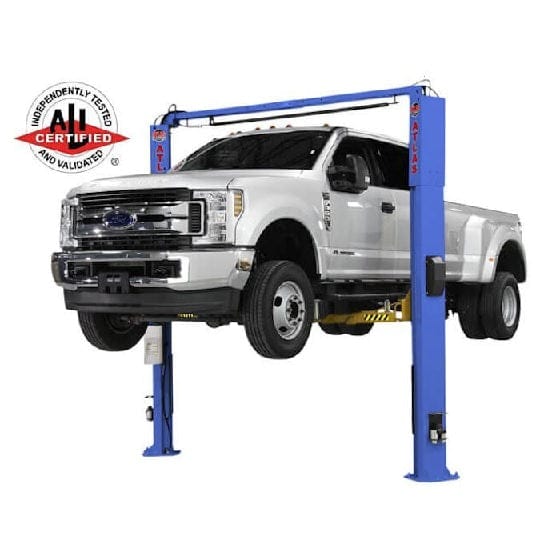

A car lift for garage can empower you to work more efficiently and safely, but what ceiling height is needed for a car lift? Making sure you have ample garage ceiling height for car lift is among the most important things to do before investing in one of these pieces of equipment.
Most home garages need at least 10-12 feet of ceiling height for a typical 2-post car lift, while the average 4-post car lift works in 9-10 foot spaces - depending on the vehicle height and runway rise, of course.
That’s an important piece of context. Low-ceiling floorplate lifts can sometimes fit in garages just over 9 feet, but you still need room for the vehicle, lift structure, and safe head clearance when working underneath.
The actual car lift ceiling height you need depends on the lift’s column height, max rise, and the tallest vehicle you plan to raise. This is the type of stuff we help our customers navigate every day. Get in touch today for one-on-one support picking the perfect lift for YOUR garage!
|
Ceiling Height |
Lift Types That Typically Work |
What This Height Realistically Supports |
|
8 ft (2.4 m) |
Portable scissor lifts (low-rise), low-rise frame-engaging lifts |
Tires/brakes, oil changes, light underbody access (no full standing-room lift height) |
|
9 ft |
Mid-rise scissor lifts, some 4-post storage lifts (shorter-column models) |
Better working height than low-rise; limited overhead clearance for stacked parking |
|
10 ft |
Floorplate 2-post lifts (low-ceiling models), many 4-post storage lifts, mid-rise scissor lifts |
Full-service 2-post use is possible with the right low-ceiling lift; storage lifts work best with normal-height cars |
|
11 ft |
Many clear-floor 2-post lifts (depending on column height), taller 4-post lifts, full-rise scissor lifts |
Comfortable two-post workflow and better headroom for SUVs/light trucks |
|
12 ft |
Most clear-floor 2-post lifts, 4-post service/alignment lifts, many parking lifts |
“Easy mode” for most residential installs; better for higher-lift points and taller vehicles |
|
13–14 ft |
Taller 2-post lifts, higher-rise 4-post service lifts, more comfortable stacked parking |
Better for vans, taller trucks, and lifts with higher max rise or taller columns |
|
15+ ft |
Commercial-height 2-post lifts, heavy-duty 4-post/alignment lifts, specialty installs |
Ideal for serious shop use, fleet work, and tall vehicle clearance without compromises |
There’s no single number that works for every setup. Ceiling height depends on how the lift is built, how high it raises, and what you’re putting on it. These are the things you need to really zero in on as you start looking closer at the possibility of buying a car lift:
All that being said, what ceiling height is needed for a car lift?
Most low-rise and mid-rise car scissor lifts work in garages with 8-9 feet of clearance because they raise the vehicle roughly 24-48 inches. That’s more than enough for brakes, detailing, and inspections - but obviously won’t cut it for full undercar service.
4-post storage lifts usually fit in spaces with 9-11 foot ceilings. The deciding factor is the stacked vehicle height. The lift itself may only rise about 70-75 inches, but the car underneath still needs room.
Floor-plate 2-post lifts are designed specifically for shorter buildings. They can operate in garages around 9-10 feet, but again, that depends on vehicle height. Overhead-bar 2-post lifts generally need 11-12 feet or more because of taller columns and cable routing.
Full-rise commercial lifts or alignment racks usually need at least 12-14 feet of vertical space, especially when lifting vans or trucks at full working height.
Our rule of thumb: match the lift’s published column height and rise to your actual garage measurements before buying. A few inches on paper can be the difference between a comfortable installation that streamlines your workflow and a lift that never reaches its full working height.
Understanding the optimal garage ceiling height for car lift installation is just one of many things you need to consider before you buy.
For instance, how thick does concrete need to be for a car lift? This is another essential spec to double-check. Most 2-post lifts need at least 4 to 6 inches of 3,000 PSI concrete. These are some other factors to think about:
The last thing you want is to start working through the installation process only to discover you miscalculated, and the lift either won’t fit your space or won’t work for what you initially purchased it for. We’re here to take that guesswork out of the equation.
Don’t stress about car lift installation. Our experts can help you confirm every detail in your garage is dialed in before you buy anything, so you’re not left dealing with retrofits or return hassles.
You’ll gain access to all the different types of car lifts from the most trusted manufacturers in the industry - Atlas, Katool, iDEAL, Triumph, Tuxedo, and more. We’ve handpicked every model and know the specs inside and out. You can trust our team to walk you through them and narrow it down to the optimal solution for your space.
Whether you’re looking for a single-post car lift, a 4-post storage solution, a 2-post car lift, or even a car scissor lift, we’ve got you covered with weight ratings from as little as 7,000lbs all the way up to 40,000lbs.
With simple financing and competitive pricing, we strive to make the car lift purchase as accessible as possible. Take the next step today!
We hope this guide to the optimal garage ceiling height for car lift has left you feeling clear on what’s possible in your space. Be sure to look beyond the spec sheet and account for height with a vehicle on the lift.
Our blog has more resources on 4-post and 2-post car lift space requirements if you’re looking to learn more. Otherwise, just connect with our experts at My Garage Supplies for one-on-one support from A to Z. Let us walk you through the details so you don’t overlook anything!
Most 2-post lifts need 11-12ft ceilings. 4-post storage lifts may need a little less - roughly 9-10ft. The actual ceiling height for car lift you need depends on the vehicles you intend to lift, too.
It’ll be tight, but low-rise, mid-rise, or floor-plate 2-post lifts and certain 4-post storage lifts with shorter columns can work with this amount of overhead space.
That works out to about 8 feet, which is likely too low for any full-rise lift. You’ll be limited to a portable scissor lift or super low-rise lift for tires, brakes, and detailing work.
You’ll have to settle for floor-plate two-posts, low-rise scissor lifts, or parking lifts designed for shorter column heights instead of standard clear-floor designs.
2-post lifts typically need 4” of 3,000-psi concrete for anchoring. On the other hand, do 4 post lifts need to be bolted down? No - this is less of an issue with 4-post or scissor car lifts.
{"one"=>"Select 2 or 3 items to compare", "other"=>"{{ count }} of 3 items selected"}