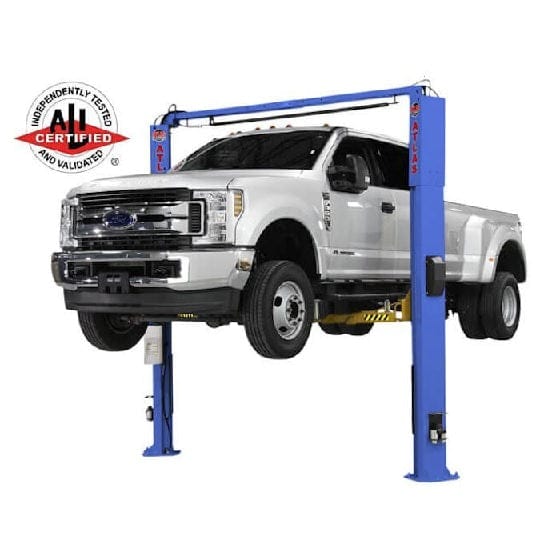

Both get you working under vehicles, but that’s where the similarities between a car lift and a service pit end. We’ve put together this quick car lift vs pit comparison to help you figure out which makes the most sense for YOUR shop. Here are the fast facts:
Learn more about the pros and cons of each below. But if you just want our take on the matter, a car lift for garage makes more sense in 99% of situations. We have the best brands and models at the lowest prices online, backed by exceptional customer service. Shop now!
|
|
Car Lift |
Service Pit |
|
Upfront Cost |
$1,500 + plus installation |
$5,000-$15,000+ (excavation, concrete, drainage, permits) |
|
Installation Time |
1-2 days (bolt to floor) |
Weeks (excavation and concrete work) |
|
Portability |
Removable (most types) |
Permanent |
|
Overhead Access |
Full (2-post and single-post) |
None |
|
Undercarriage Access |
Full |
Full |
|
Ceiling Height Needed |
11-12 ft minimum for full-rise |
Standard ceiling works |
|
Primary Safety Risks |
Mechanical/hydraulic failure |
Falls, water and gas buildup |
|
Best For |
Full-service repair, wheel/brake/suspension |
Oil changes, exhaust, undercarriage inspections |
There’s a reason almost every commercial automotive shop and even some home garages these days have a car lift. They’re versatile, portable, and come in configurations that fit YOUR layout, no matter what that may be.
A 2-post car lift gives you full undercarriage and overhead access on the same setup. A 4-post car lift doubles as vehicle storage when it's not being used for service. There are even portable scissor lifts that can be pushed out of the way when not being used.
Before there were car lifts, technicians worked on cars by lowering themselves into a pit below the floor and reaching up to work on the vehicle’s undercarriage. They’re still really common in Europe and in older shops here in North America, but you won’t find too many being installed these days. They’re just not as practical, and you’ll soon see why.
You probably get where we’re going with this car lift vs pit comparison…one is just more practical than the other, and it’s easy to see which that is by now. Let’s take a closer look at the two side-by-side based on what matters most, though.
There are real risks with both service pits and car lifts. Automotive work is never 100% risk-free.
A car lift can fail mechanically if you use it improperly or don’t give it the maintenance it deserves. The main failure points are hydraulic leaks, worn cables, and corroded lock mechanisms. Of course, these are non-issues with ALI-certified equipment and a proper maintenance schedule.
On the other hand, service pits have different types of hazards - most notably, someone falling into them. An open pit is a massive liability in a busy shop, and it’s always there. There’s also the water accumulation, exhaust fumes, and fuel vapors we spoke to earlier on. OSHA treats pit ventilation as a serious compliance matter in commercial settings.
This is what your employees will care about more than anything else between a car lift vs pit. Which is more comfortable to work with? Again, the lift has an undeniable edge.
Car lifts can raise a vehicle to whatever height is optimal for the job at hand. Lift it 3 feet off the ground to access the brakes. Lift it 6 feet to get to the undercarriage. All the while you’re standing upright to keep fatigue to a minimum.
Meanwhile, car lifts force you to reach up to access whatever it is you’re working on. You might be doing this for hours throughout the average workday. The pit is fine for quick oil changes and undercarriage inspections, but not very convenient for anything that involves removing components from the vehicle.
Your choice between a car lift vs pit will be shaped by the type of work you do, at least to some extent. A car lift just gives you more than a service pit can. For instance:
A single-post car lift handles most of this in a smaller footprint than a 2-post if you don’t have a ton of space to spare. But what do you get access to with a service pit? Just the undercarriage.
That may not be a dealbreaker if all you do is oil changes and fluid checks. Even exhaust repairs are manageable from a pit. However, anything that requires the wheels off or overhead engine access sends you back to jack stands or, eventually, a lift.
You’re going to shell out quite the chunk of change either way. It’s just a matter of what delivers better value for your money. At the risk of sounding like a broken record, that’s a car lift.
A quality 2-post lift starts around $1,899 for the equipment. The total still comes in well under most pit construction projects when you factor in installation costs for concrete anchoring and electrical (if 220V isn't already available).
On the other hand, building a service pit calls for excavation, forming, pouring, drainage, and waterproofing. Each phase has its own labor and materials. Permits alone can take weeks in some municipalities.
Yes, you avoid any sort of ongoing costs with a service pit. A car lift means ongoing hydraulic fluid checks and cable inspections. Maybe even some seal replacements. But, these are small prices to pay for what you’re getting out of the lift.
You’ll need to confirm you have the ceiling height, concrete depth, and 2-post lift layout dimensions to make one work - but most garages can accommodate. Or, you can go with a single-post life, a four-post lift, or a portable scissor lift to save space. Just don’t bother with a DIY car lift - too risky.
Meanwhile, a service pit is a totally different scale of project. Like we just touched on above, it means cutting concrete and excavating. Then comes forming and pouring. Drainage has to be installed before the floor goes in. Waterproofing follows. It can take weeks from A to Z, even in new construction where the pit is planned from the get-go.
We think the choices between a car lift vs pit is a no-brainer for pretty much every garage owner out there. A car lift gives you far more versatility as far as the jobs you can do, it’s more comfortable to work with, and it’s more practical from a cost/installation standpoint.
My Garage Supplies stocks the top models from the best car lift brands (learn about BendPak vs Atlas in our blog if you’re not sure where to start). More importantly, though, we back up our lifts with world-class customer support every step of the way. Take the next step today!
The answer is almost always NO. A service pit really only frees you up to take on oil changes and other fluid inspections - maybe some exhaust jobs. But a car lift handles all that PLUS wheel-off service (wheels, brakes, transmission, engine, etc.). It’s just more practical for the vast majority of shops.
A 2-post lift is more popular for general service, while 1-post lifts give you a little more flexibility in layout. A 4-post lift is great for storing vehicles and alignment work. There are even portable scissor lifts that you can move out of the way if need be.
AMGO, Atlas, Titan, Triumph, Katool - those are the names that come to mind. All of them are available here at My Garage Supplies at the lowest prices online.
Best equipment, better customer service. Low prices. What more could you ask for? Get in touch with our experts today for one-on-one support.
{"one"=>"Select 2 or 3 items to compare", "other"=>"{{ count }} of 3 items selected"}